



Authors
Bruno Rodilha and Larissa Corte · Product & Design · Capim
Humanizing an AI is not a cosmetic exercise: it’s a strategic decision that directly affects product adoption. That’s what we learned building the identity of Camila, Capim’s scheduling assistant. Since the identity launched, 113 new clinics connected to the product — and activation, which used to depend on 3 days of manual support, became a 35-to-40-minute self-serve experience. This post walks through the process: from user research to the character, from voice to the hybrid WhatsApp flow.
The problem: interest without activation
In August 2025, we discovered that the success of an AI solution goes far beyond its ability to give fast answers. An agent’s intelligence needs to be perceived through its identity, from the very first contact. After all, first impressions stick.
That month, we were following the beta phase of Capim’s scheduling assistant, built to serve patients over WhatsApp and book appointments. We were confident about opening the product to a larger group of users — we had run internal tests and put it to work in a few partner clinics.
A few weeks after making the assistant available to more users, we noticed that a significant share of clinics showed interest in the product but never completed activation. Our concern shifted from whether the assistant worked to why users were giving up before even trying it.
To understand what was happening, we interviewed 12 users who had gone through the assistant’s activation flow. The conversations surfaced two kinds of barrier:
-
Operational friction The connection process required two devices, but that requirement wasn’t communicated upfront. Hitting it by surprise, many users simply abandoned the flow.
-
Emotional distance Users had little understanding of how an AI tool worked, the product’s language was too technical, and that distance bred distrust in the assistant.
For clinics to finally use the product and improve their scheduling routine, we needed to fix the activation flow, making it more intuitive, and create an identity that built closeness and trust.
Building the identity
Personality attributes
The scheduling assistant could no longer exist as just a speech bubble inside WhatsApp. It needed to inhabit the same world as our users. Managing appointments in a dental clinic is, in most cases, a job done by a person — and that’s where we started building the assistant’s identity: by getting close to the people who actually do that work, the clinics’ receptionists and secretaries.
Before thinking about visuals, we studied how these professionals communicate with patients. We did this through mystery-shopper conversations and by analyzing excerpts of human service interactions recorded with the beta clinics. From those observations, we defined the attributes that should guide the assistant’s identity:
- A dynamic, confident and helpful personality.
- Simple, clear and empathetic communication.
- A human, direct and approachable tone of voice.
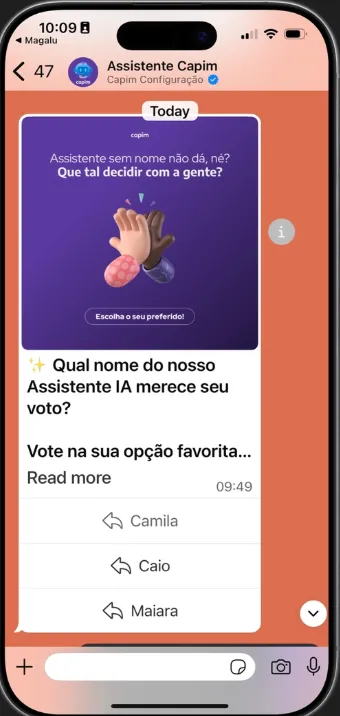
With the attributes set, we moved to naming. Six options were created, narrowed down to three finalists after aligning with stakeholders. The three options were then sent to the beta clinics via WhatsApp — an initiative that, beyond collecting preferences, created a sense of ownership in the process. With 25 votes, the chosen name was Camila.
Visual aspects
With the attributes defined, we had to materialize them visually. For users to feel close to Camila, we decided to create a character: a young woman with traits blending multiple phenotypes. Youth conveyed the dynamic, helpful personality we wanted, while the diversity of traits was a deliberate choice so she could be recognized by the diversity of the Brazilian public.
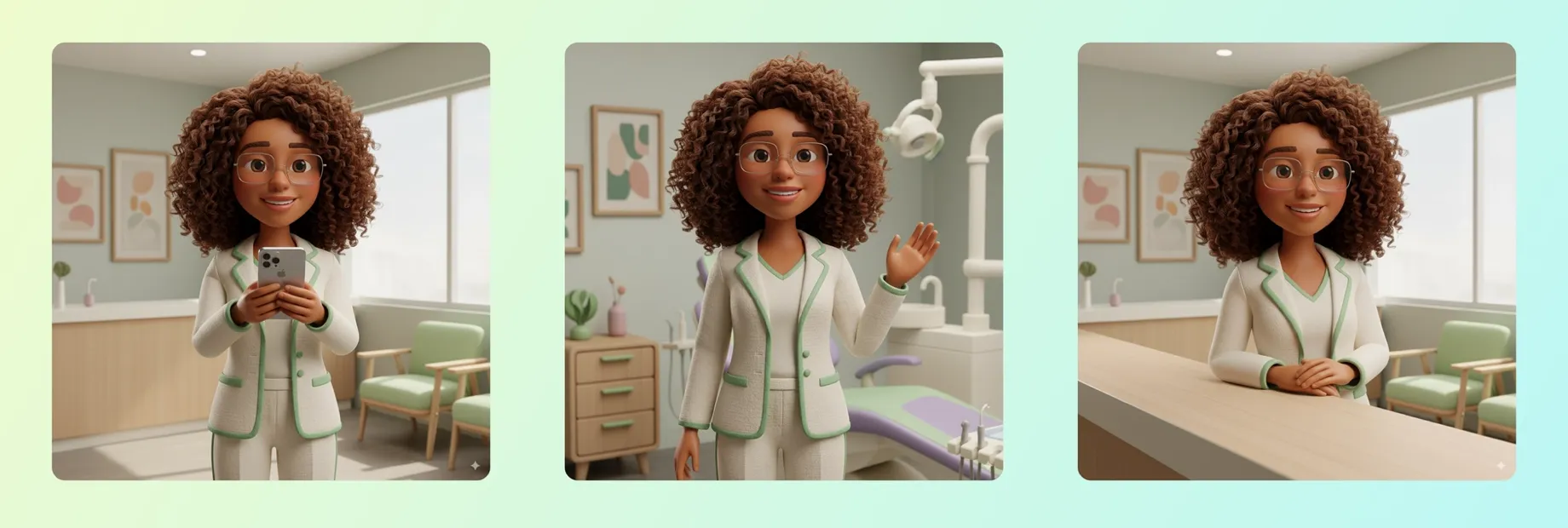
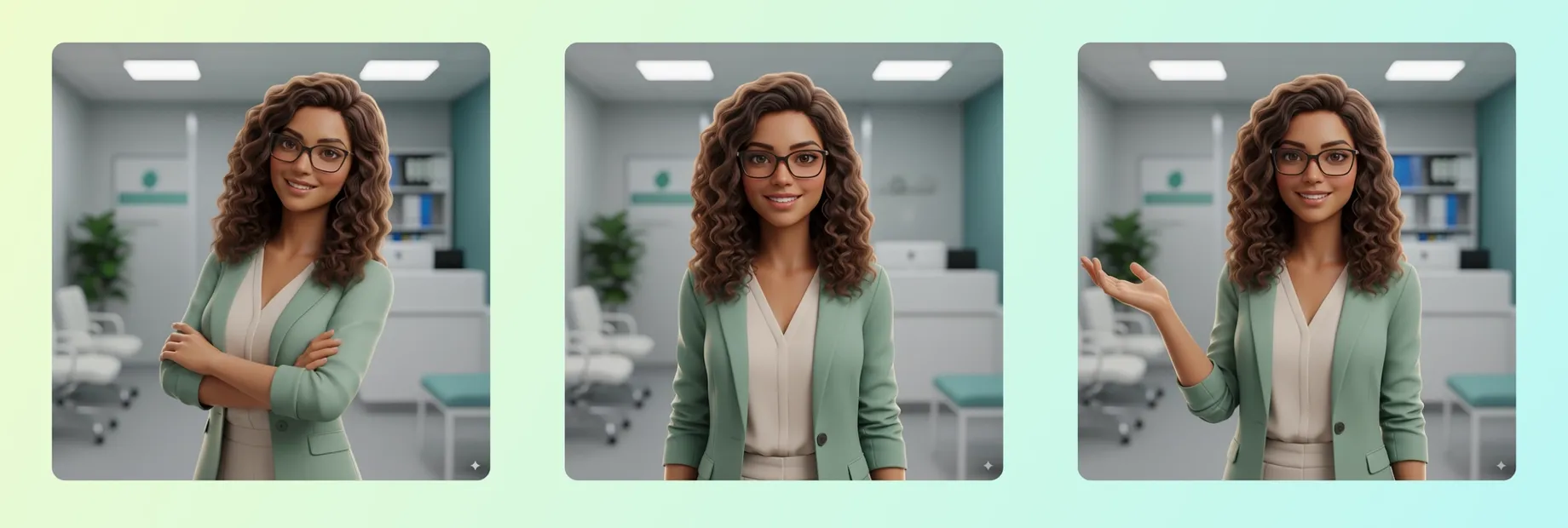
The visual development was also a lab for experimenting with AI tools. We used AI Studio with Nano Banana to generate and refine alternatives across three distinct visual languages:
- Cartoon: friendlier and more approachable
- Techie: modern and to the point
- Photorealistic: focused on warmth and closeness
Cartoon version
Techie version
Photorealistic version (chosen)

After validating with the rest of the product team, we chose the photorealistic direction. We wanted to reduce the perception of distant technology and reinforce a sense of closeness — and the photorealistic approach translated that intent best, both in its appeal to our audience and in the superior quality of the generated images. At that point, AI Studio delivered more consistent results for photographic styles than for more graphic ones.
To guarantee consistency when generating new poses, we built a prompt-specialist agent (DUCA), responsible for turning Camila’s visual and personality guidelines into structured, reproducible instructions.
After many iterations — adjusting framing, lighting and standardizing terms — the process produced a bank of 20+ character variations, along with documented prompts and reusable assets for other teams. The visual identity stopped being just an aesthetic choice and became a scalable asset.
Conversational identity
Camila’s main presence in the world is through conversations with dentists and patients. So building her conversational identity demanded the same care as her appearance. We translated her personality attributes and visual traits into conversation guides, so her voice would be as recognizable as her face.
Beyond the friendly tone, which was a premise from the start, we structured her communication around five principles:
- First person: creating a sense of presence and accountability, as in “I’ll help you connect your clinic.”
- Anticipating questions: especially at critical steps of the flow, defusing the user’s anxiety before it appears.
- Simple language: avoiding technical terms like “authentication” or “integration”, which create distance instead of closeness.
- Progressive guidance: presenting one step at a time, reducing cognitive load.
- A supportive stance: replacing cold, impersonal messages with empathetic responses.
Redesigning the experience
A hybrid conversational flow
The first contact with Camila happens through a WhatsApp conversation, during the activation flow. That’s when the user needs to give the assistant context about the clinic and grant the access she needs to operate.
This flow had to balance two seemingly opposite needs: guiding the user safely through the most complex steps, while leaving room for natural conversation. To do that, we combined moments with predefined messages — where control mattered most and abandonment risk was highest — with moments of greater freedom, where the generative LLM could engage with more open, varied contexts.
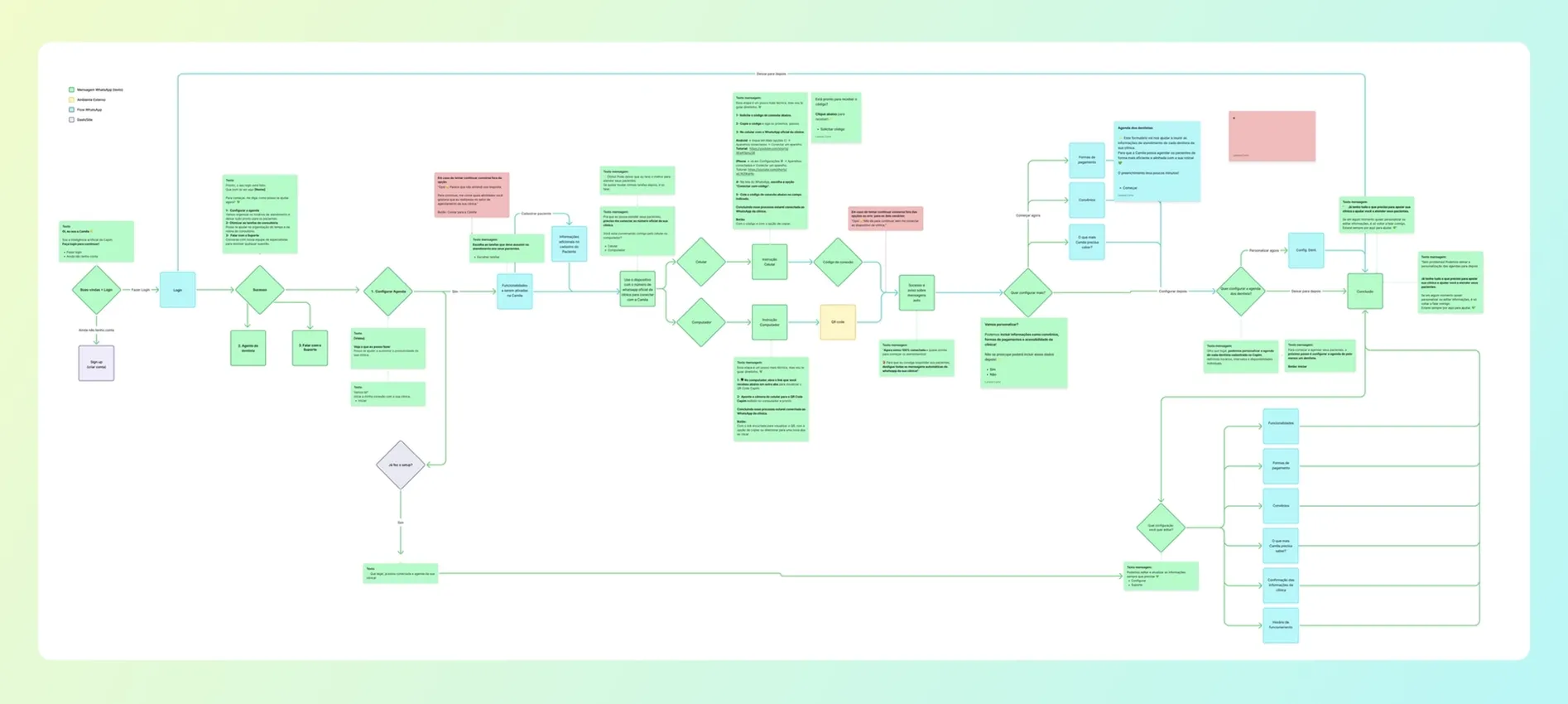
The flow mapping when predefined messages fire and when the LLM takes over the conversation.
To make data entry smoother, we integrated Meta’s WhatsApp Flows into the conversation. Interactive patterns like selectors and forms became a natural part of the flow, letting the user complete the whole process without leaving WhatsApp — combining dialogue and interface into one continuous experience.
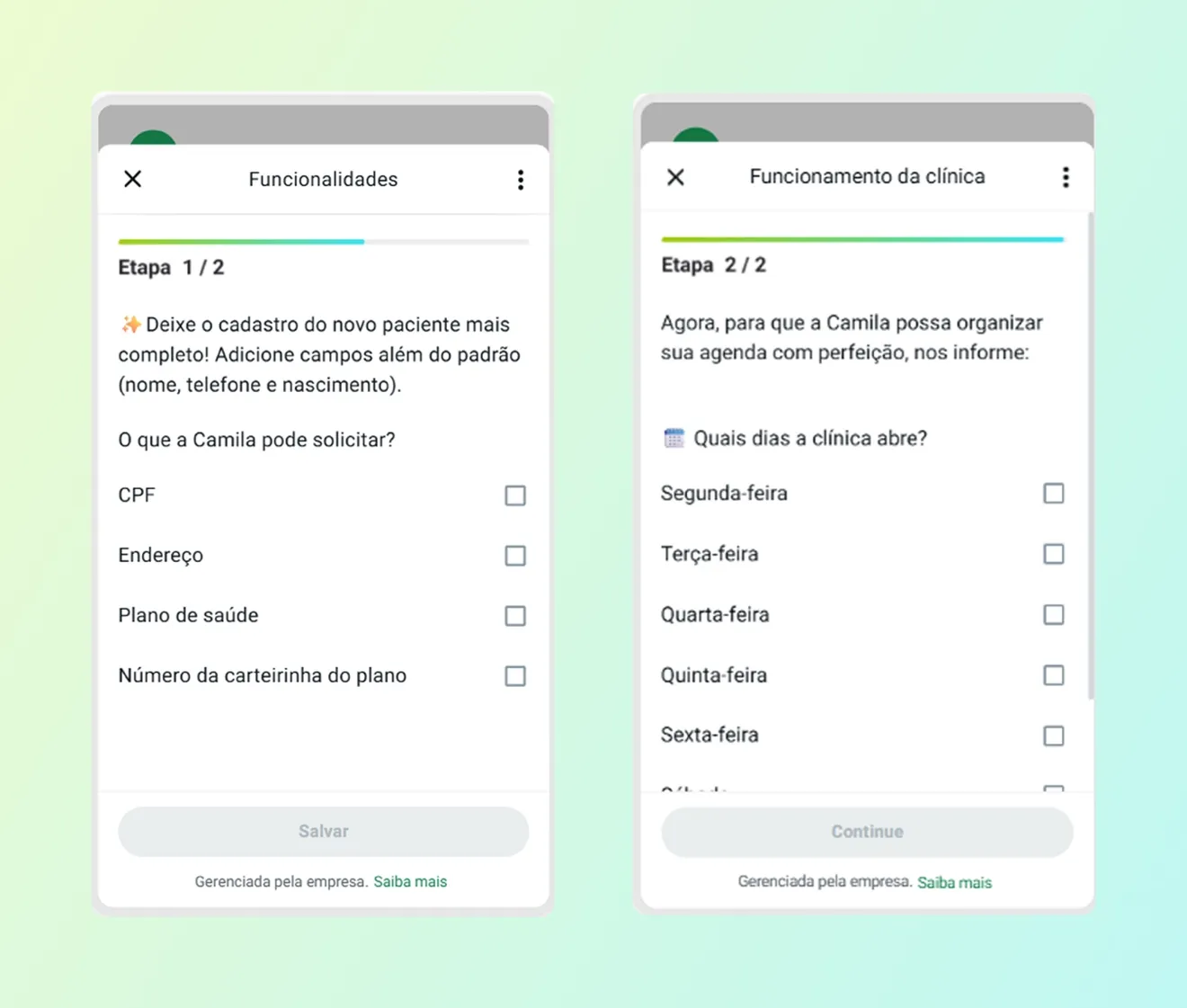
This hybrid structure reflected the identity we built for Camila and, at the same time, made the flow more effective. The assistant could follow a script without sounding like a robot, and the user interacted in an environment they already knew, with nothing new to learn before starting.
Videos to build identification
We shipped the first version of the flow — now with visual identity and personality, mixing predefined messages and open dialogue. But after the first users went through it, we realized written communication wasn’t enough to create emotional connection or to clarify key moments of the journey.
To solve that, we produced videos from Camila’s visual assets. These short clips were placed along the flow, both to introduce the product and to support the user at critical moments — like connecting WhatsApp across two devices.
To bring Camila to life, we generated the clips with Veo 3, using the previously created images as a starting point. We organized those images into a storyboard and scripted each sequence directly in the prompt, describing transitions, lighting and camera moves.
Since Veo 3 limits clip length, we exported the material to a video editor, where we stitched the sequences together and mixed the audio. The result was a set of videos showing Camila in motion, preserving the visual consistency built throughout the whole process.
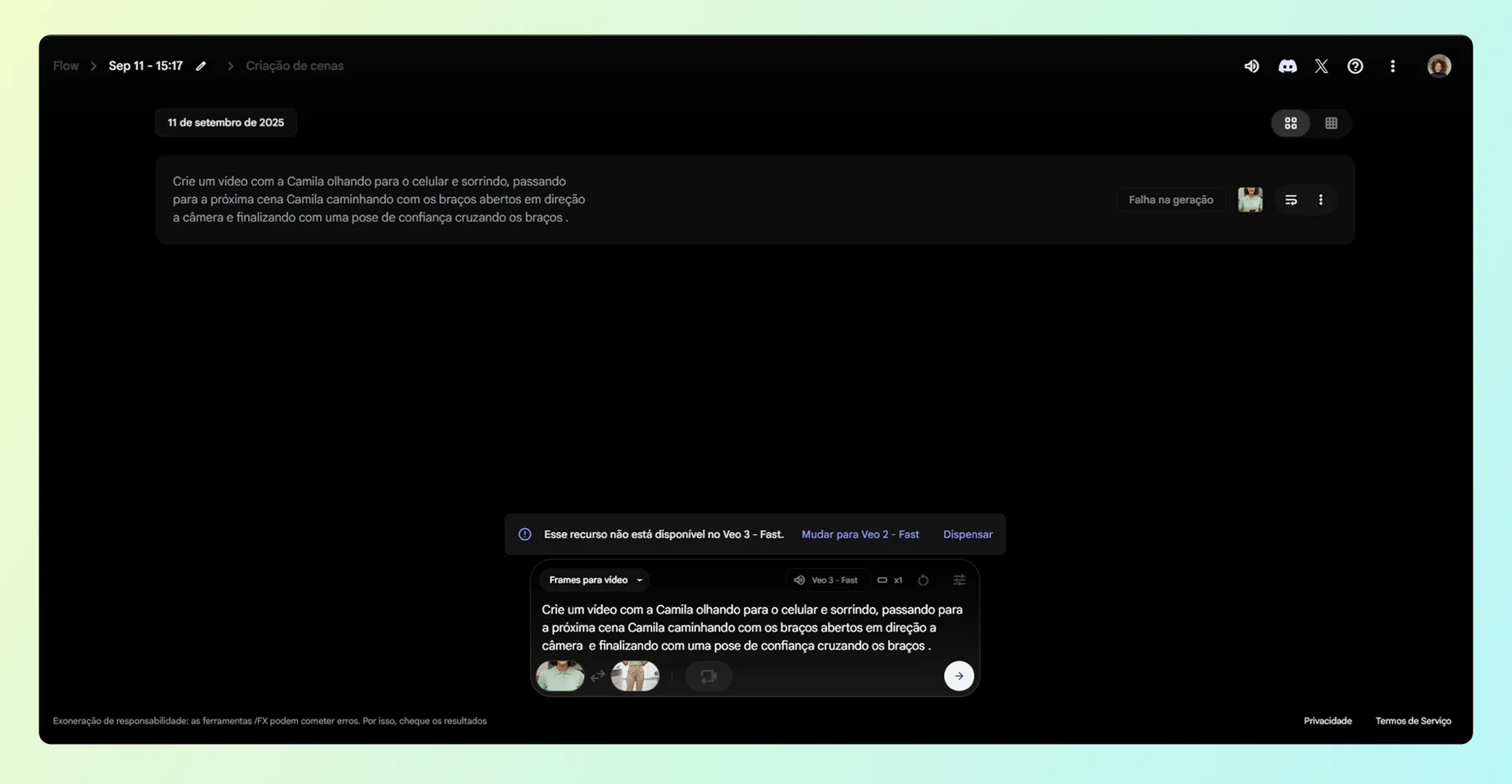
The video creation process using Veo 3.
What we learned
The result was an immediate shift in perceived value: since the identity launched, 113 new clinics connected to the product, consolidating a base of 245 active clinics.
More than volume, the new identity unlocked the scalability we were after. The redesigned flow, now led by a human, welcoming presence, turned what used to be a 3-day manual support process into a 35-to-40-minute self-serve experience.
The process taught us that humanizing an AI solution is not a cosmetic exercise. It’s a strategic decision that directly affects product adoption. Three principles guided this work and may help other teams facing similar challenges:
- Identity precedes functionality: a technically capable assistant is worthless if the user can’t build a relationship of trust before activating it.
- Consistency turns identity into credibility: name, looks, voice and behavior need to tell the same story.
- Users want to be guided, not surprised: anticipating questions, simplifying steps and reducing friction are forms of respect, not just usability.
Camila keeps evolving. But what stayed with us from this process is the certainty that, for an AI to be perceived as intelligent, it first needs to be perceived as present.